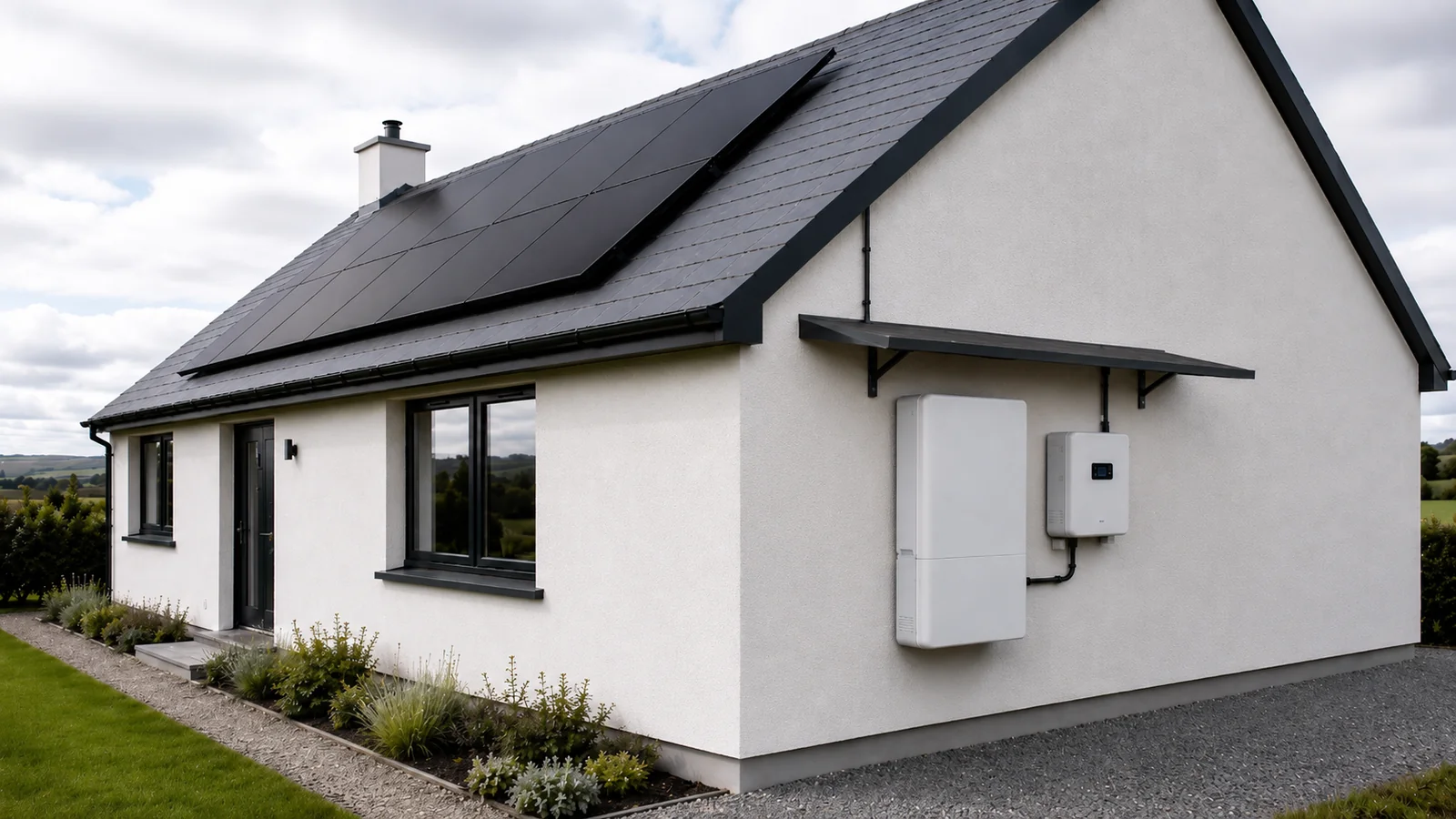
Should You Add a Battery to Solar Panels in Ireland?
Should you add a battery to solar panels in Ireland? Learn how solar batteries, night-rate charging and battery arbitrage work, and how AirPV estimates savings.
Should I get a battery? This is one of the most common and important questions for homeowners.
A battery can increase your savings by helping you use more of your own solar electricity. With the right smart tariff and battery controls, it can also create extra savings by charging from the grid when electricity is cheap and using that energy later when electricity is more expensive. This is known as battery arbitrage.
But a battery also adds cost, and the value depends on your home, your solar system, your electricity usage, your tariff and how the battery is controlled. That is why AirPV includes a detailed battery model in the solar calculator.
So is it worth it? Often yes, but it depends. Let's walk through the detail.
Quick guide
- Is a battery essential? No. You can install solar panels without a battery and still save money by using solar in the home and exporting excess electricity to the grid. Adding a battery can increase savings, but it also adds cost.
- What are the main benefits? A battery can increase savings by helping you use more of your own solar electricity and, with the right tariff and controls, by charging cheaply at night for later use.
- How much does a battery cost? It costs around €2,000 to add a battery to your solar installation, depending on the system and size.
- Is there a battery grant? There is currently no separate SEAI domestic battery grant. The SEAI Solar PV grant is based on solar panel capacity and is capped at €1,800. [1]
- What about VAT? Solar PV installations on private homes are generally zero-rated for VAT. Batteries can also be zero-rated where they are supplied and installed with the solar panels as ancillary equipment under the same supply-and-install contract. A standalone battery added later may not get the same VAT treatment. [2]
- Who gets the best value from a battery? Usually homes with higher electricity usage, a useful cheap night-rate tariff, and a battery/inverter setup that can manage solar storage and tariff charging properly.
- How do I check? Use the AirPV calculator to compare solar-only, solar with battery, and solar with battery arbitrage.
How a battery saves money
A home battery can save money in two main ways.
1. Storing solar for use later.
Solar panels produce electricity during daylight hours. But your home may not need all of that electricity at the exact time it is produced. Without a battery, excess electricity is exported to the grid and paid at the export rate provided by your supplier.
With a battery, some of that spare solar can be stored and used later, for example in the evening. You save the most money when you use the solar yourself, since this avoids buying electricity from the grid at your import rate.
For example, if your day import rate is 35 c/kWh and your export rate is 20 c/kWh, you save an extra 15 c/kWh when you use the solar in the home. The exact difference depends on your actual tariff.
2. Battery arbitrage.
Some batteries can also charge from the grid during a cheap night-rate window. The battery can then discharge later when grid electricity is more expensive.
For example, a battery might charge at 10 c/kWh overnight, then power the home during the day or evening when electricity would otherwise cost 35 c/kWh. Some battery setups may also export stored energy to the grid, at say 20 c/kWh.
This is why the battery result depends so much on your tariff. A large gap between cheap night electricity and day electricity makes battery arbitrage more valuable.
Simple example: 5 kWh battery arbitrage
Let’s use a simple example.
Assume:
- 5 kWh usable battery
- 90% round-trip efficiency
- 35 c/kWh day rate
- 10 c/kWh cheap night rate
- 20 c/kWh export rate
Because the battery has losses, you need more than 5 kWh from the grid to fully charge a 5 kWh battery. With 90% round-trip efficiency:
Charging energy needed = 5 / 0.90 = 5.56 kWh
Cost to charge = 5.56 x €0.10 = €0.56
In the best theoretical case, the full 5 kWh is later used in the home instead of buying electricity at 35 c/kWh:
Day electricity avoided = 5 × €0.35 = €1.75
Net saving per day = €1.75 − €0.56 = €1.19
Annual saving = €1.19 × 365 = €436
In a worst-usage case, all of the battery energy is exported at 20 c/kWh instead of being used in the home:
Export value = 5 x €0.20 = €1.00
Net saving per day = €1.00 - €0.56 = €0.44
Annual saving = €0.44 x 365 = €162
So under these example tariffs, a perfect full-cycle 5 kWh battery has a theoretical arbitrage value between about €162 and €436 per year, depending on whether the battery energy is exported or used in the home.
In reality, batteries do not complete perfect full cycles every day, and not all remaining household demand happens when the battery can serve it. The AirPV model adjusts for this using practical utilisation and capture assumptions.
How the AirPV battery model works
The AirPV battery model accounts for the size and type of solar system, the electricity demand of the home, the home usage pattern and electricity rates. The result is a transparent annual estimate rather than a full dispatch simulation.
The model first calculates how much solar electricity is produced, which depends on your location, roof tilt and direction, level of shading and number of solar panels. It then calculates how much solar is used in the home based on your electricity bill, how often you are at home and how much solar the battery can store for later use. This provides the savings for 'solar used in home'. Any remaining solar is exported to the grid at the export rate. Both of these values are shown as results from the AirPV calculator.
The model then calculates battery arbitrage savings. The battery charges at the cheap night rate and then can offset any remaining home demand (not already covered by solar) or export to the grid. The AirPV calculator includes a separate line for battery arbitrage savings.
Technical note
After accounting for solar-covered demand, the remaining high-cost home demand can be met by arbitrage. The rest of the arbitrage energy is sold to the grid, for slightly reduced savings compared to meeting home demand.
In practice, the battery will not work perfectly all the time. Some days it may not be able to charge fully on the cheap night rate. And some days it may not be able to always meet the remaining home demand. To account for this, the model then applies simple utilisation (u) and capture (c) assumptions to estimate how much of the remaining demand can realistically be met by battery arbitrage.
The following are the current base-case values. A separate technical paper will cover battery model in more detail.
5 kWh battery: u = 0.95, c = 0.85
10 kWh battery: u = 0.90, c = 0.80
Round-trip efficiency: 90%
Other benefits of battery storage
Dynamic pricing and future grid services
Dynamic electricity tariffs are now being introduced in Ireland, with electricity prices able to vary every half-hour based on wholesale market prices. This can create additional opportunities for compatible smart battery systems to charge when electricity is particularly cheap and use the stored energy when import prices are higher.
Further opportunities may also emerge through demand-response programmes or virtual power plants (VPPs), where household batteries can be coordinated to support the electricity grid. These arrangements are still developing and should be considered potential additional value rather than guaranteed savings.
The benefits will depend on the tariff, battery controls and market arrangements. AirPV's current battery estimates do not assume dynamic-price or grid-service optimisation.
Backup power during outages
A battery can also provide backup power during a grid outage, although the level of backup depends on the equipment and how the system is installed.
The simplest option with some systems is a dedicated backup socket, which is essentially an outlet that can be used to power essential devices during an outage. This is a relatively cheap and simple solution, but the setup and functionality depend on the particular equipment and system configuration.
For more comprehensive backup, a gateway or changeover arrangement can isolate the home safely from the grid and can allow the solar and battery system to continue operating during an outage. This typically involves an additional cost, often in the region of €1,000–€2,000, although this can vary significantly depending on the equipment and electrical work required.
The system can be configured to supply selected essential circuits (partial-home backup) or, with suitable equipment, most or all of the home's circuits (whole-home backup). Some systems can switch automatically with little or no noticeable interruption, while others use a manual changeover arrangement.
There are still power and energy limits. How long the home can remain powered depends mainly on the battery charge when the outage begins, the loads being used and the solar generation available during the outage. Large loads may need to be avoided, and if the battery becomes depleted with insufficient solar generation, backup power will stop until sufficient solar energy or the grid becomes available again.
So, should you get a battery?
A battery is often a good fit if:
- you use a lot of electricity,
- you have a smart tariff with a cheap night rate,
- you have enough solar generation to fill the battery for part of the year,
- you are often out during the day and use more electricity in the evening,
- you want to reduce imports from the grid,
- your installer provides a battery/inverter setup that can manage solar storage and tariff charging properly.
- you want a backup power option during a grid outage
- you want exposure to other potential benefits like dynamic pricing and future grid services
A battery may be less attractive if:
- your electricity use is low,
- your export tariff is high relative to your import tariff,
- you do not have a useful cheap night-rate tariff,
- you already use most of your solar during the day,
- there's conflict with EV overnight charging during the cheap electricity window,
- the installed battery cost is high.
The best answer is not a generic yes or no. It depends on your home. That is why AirPV lets you test solar-only, solar with battery, and solar with battery arbitrage using your own roof, bill and tariff assumptions.
Notes for Ireland
- Export payments. Irish households can be paid for excess electricity exported to the grid through the Clean Export Guarantee. Suppliers set their own export tariffs, so the export rate can change by supplier and over time. [3]
- Tax exemption. Income from selling electricity back to the grid is tax-exempt up to €400 per year for residential homeowners, currently in place until 31 December 2028. [4]
- Smart meters. A smart meter helps measure export more accurately. Without a smart meter, export payment may be based on a deemed export calculation rather than precise half-hourly export. [5]
- NC6 and grid connection. For microgeneration, your installer normally submits the NC6 form to ESB Networks. ESB Networks’ microgeneration guidance covers the connection process, microgeneration limits and export arrangements. [6]
- EV charging. If you charge an EV overnight on a cheap tariff, that can reduce battery arbitrage value. The EV is already using cheap electricity directly, without battery losses, so EV charging may take priority over charging a home battery from the grid.
- Backup power. A battery does not automatically mean your home will have power during a power cut. Backup power usually requires additional equipment and correct installation. Ask your installer whether the battery supports backup or island mode, what circuits are backed up, and what happens during an outage.
- Installer quality and safety. Solar and battery systems should be installed by competent registered professionals. Safe Electric advises using a Registered Electrical Contractor and asking for a completion certificate.
Ready for solar quotes or to use the calculator?
Simply Enter your Eircode on AirPV and you will see quotes in seconds from local, trusted installers. No waiting days for quotes to be sent on by email. You get access to the solar calculator where you can test different number of panels, roof tilt, direction, shading and more. You can also test the impact of adding a battery, including battery arbitrage savings.
AirPV is free, private and no spam. No obligation, no fuss.
Have questions? Or like a free custom calculation to see the number of panels for your home?
Email: scott@airpv.ie
Scott, Founder of AirPV
[1] https://www.seai.ie/grants/home-energy-grants/individual-grants/solar-electricity-grant
[2] https://www.revenue.ie/en/tax-professionals/tdm/value-added-tax/part03-taxable-transactions-goods-ica-services/Services/solar-panels.pdf
[3] https://cruie-live-96ca64acab2247eca8a850a7e54b-5b34f62.divio-media.com/documents/Clean_Export_Guarantee-Enduring_Arrangements_to_Remunerate_Customers_for_Microgenerati.pdf
[4] https://www.revenue.ie/en/tax-professionals/tdm/income-tax-capital-gains-tax-corporation-tax/part-07/07-01-44.pdf
[5] https://www.seai.ie/sites/default/files/publications/Homeowners-Guide-To-Solar-PV.pdf
[6] https://www.esbnetworks.ie/services/get-connected/renewable-connection/micro-generation