How Many Solar Panels Do I Need for My Home in Ireland?
Learn how many solar panels your home may need in Ireland, based on roof space, electricity use, system size, export limits and battery options.
Many homes in Ireland will install around 8 to 14 solar panels, but the right number depends mainly on your usable roof space, electricity demand, inverter/export limit and budget. How many should I get and what's the max number of panels? In short, bigger is usually better but most homes are limited either by the size of the roof or the export limit. Let's dig into these points.
Typical guide for Irish homes
- Small roof: 4–7 panels
- Typical home: 8–14 panels
- Larger roof / EV / heat pump: 15–22 panels
A typical home
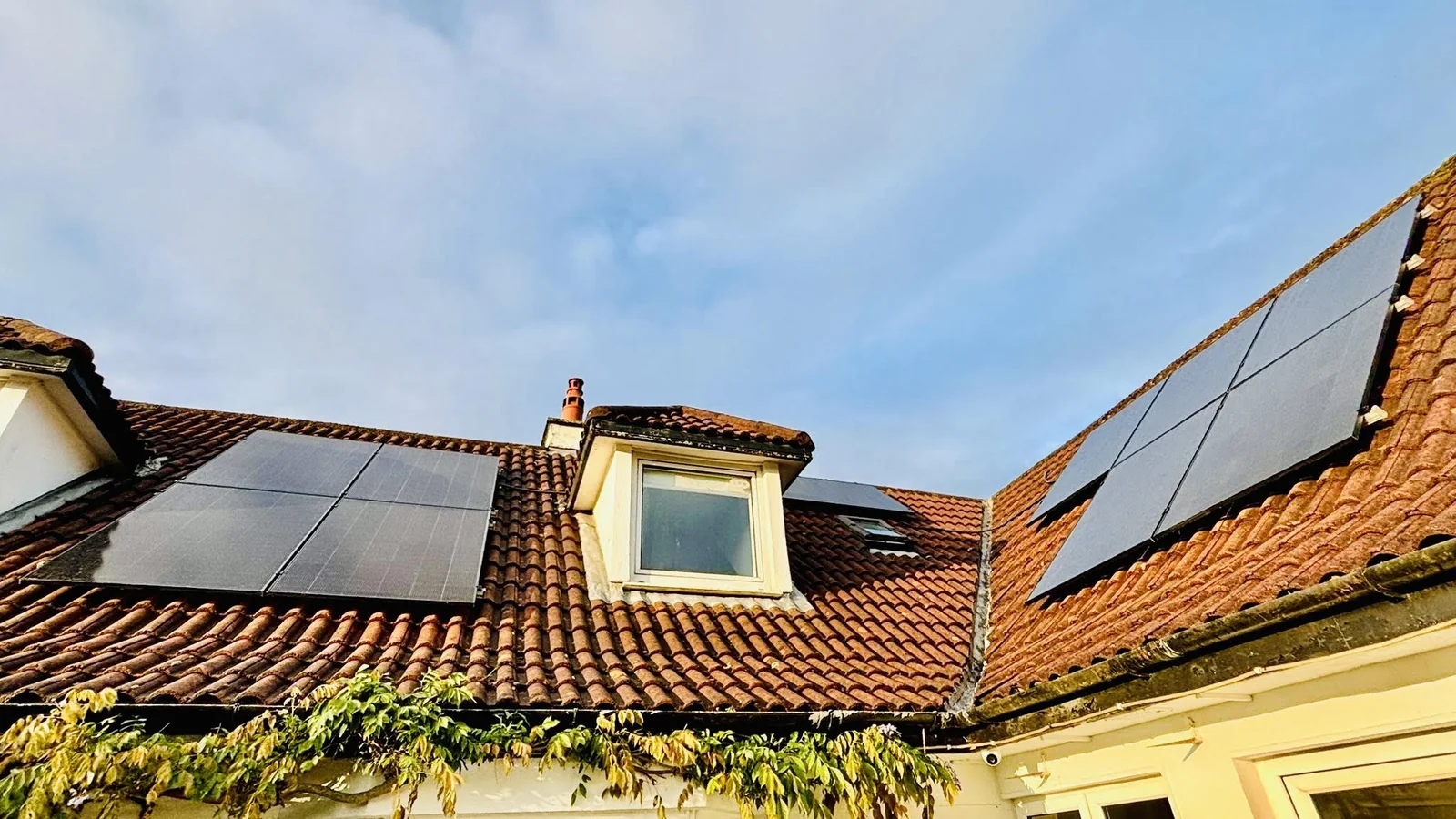
Let's start with a typical three-bedroom house, which is the most common in Ireland [1]. These homes often have enough south, east or west roof space for around 10 panels. A 10 panel system is 4 - 5 kWp and can produce 3,000 - 5,000 kWh per year. Many homes can use the majority of the solar produced and can have payback times around 5 years - for more on the economics, see our blog post.
In addition to panel count, the production mainly depends on your location, the direction your roof faces and if there is any shading. You can test the impact of location, roof direction, shading and more with the AirPV calculator.
How many homes can actually fit 10 panels? A report by MaREI studied this very question and found that over 1 million homes in Ireland have suitable roof space for 10 panels [2].
Technical note: A typical panel is 450 Wp or 0.45 kWp. The 'p' refers to peak power, which is basically the power the panel can produce in full sun. A typical panel size is around 1.8 m long and 1.1 m wide or roughly 6 ft x 3 ft. So for a 10 panel system, this takes up around 20 m2 or around 200 square feet.
Total panel power and area
# panels x panel power = 10 x 0.45 kWp  = 4.5 kWp
# panels x panel area = 10 x (1.8 m x 1.1 m) =  19.8 m2
Example: Solar production in a day
Let’s take an example home with 10 panels, giving a system size of 4.5 kWp, on a south-facing roof with little or no shading. Assume the home uses around 11 kWh of electricity per day. In full sun, the system could produce close to 4.5 kW at that moment.
So how much electricity can solar panels produce in a day? That depends on your location, the season and the weather - solar panels still work in cloudy conditions but you produce less. A simple Irish rule of thumb is that each 1 kWp of solar installed can produce around 2.5 kWh of electricity per day on average across the year. So a 4.5 kWp system could generate about 11 kWh per day.
4.5 × 2.5 = 11.25 kWh per day on average
In practice, output is much higher in summer and lower in winter, roughly twice as much in summer as winter (see monthly plots in AirPV calculator). And because solar electricity is produced mainly during the day, how much of this directly covers your home’s demand depends on when you use electricity and whether you have a battery. Overall for the year, you tend to use at least half of the solar you produce - more details below.
What is a good roof for solar?
Ideally you want south, east or west facing with no shading and even better if you live in the south of the country or near the coast. You will get the most production with a south-facing roof but East and West still work very well. You can also split panels across different roof directions on your home. An east-facing roof tends to give more generation in the morning, while a west-facing roof tends to give more in the afternoon and evening. A nice sunrise and sunset boost!
Solar panels can be installed on most common roof types, such as slate and tile, but you do need usable free space and some clearance from obstacles like chimneys, vents and skylights. It is also important to avoid significant shading such as from nearby trees and avoid the north-facing roof section.
Home usage
How much of the solar electricity will directly power your home? This depends on how much solar you produce, how much electricity your home needs, when you use it, and whether you have a battery. This varies a lot from home to home but homes tend to use at least half of the solar produced.
Using solar directly usually gives the biggest savings, because you avoid buying electricity from the grid at the normal retail rate of around 35 c/kWh. Any solar you do not use can be exported to the grid for a credit on your electricity bill of around 20 c/kWh, with the exact rate depending on your supplier. A battery can increase your self-use by storing excess solar for later.
The average home uses 4,200 kWh [3] per year but electricity demand is rising, especially with EVs and heat pumps [4]. The more electricity your home needs, the more you can use the solar produced. Electricity demand in the home is mostly during the day with peaks in the morning and evening. You will use more of your solar electricity if you run appliances such as washing machines and dishwashers during the day. A battery can also help by storing solar electricity for use later, such as in the evening. Some batteries can also bring extra savings by charging when grid electricity is cheap.
When you have lots of space for panels
For the typical home we discussed above, the number of solar panels is limited by roof space. But what if you have plenty of space for panels? Then the limit is based on your ESB connection, which sets an inverter/export limit [5]. Note the inverter is the box that converts the DC electricity from your panels to AC electricity that can be used in the home or exported to the grid. The majority of homes in Ireland are single-phase connection where the ESB export limit for the inverter is roughly 6 kW. In practice many installers end up using a slightly smaller inverter size of 5 kW.
However, you normally install more panel power than inverter power - this is called oversizing or overloading. With overloading, you may lose some power when it is very sunny but you end up gaining a lot more across the year in lower-light conditions. And some batteries can store this oversized solar power so you don't lose it but instead save it for later.
More panels also tend to be a better deal because of economies of scale. A lot of the installation cost is in scaffolding, labour and getting the installer to site, so adding a few extra panels is often relatively cheap. Of course, not everyone has the roof space or budget for a larger system, and some homeowners are happy with a smaller system that they use more of directly in the home.
Technical note: For a 5 kW inverter, it is common to have 14 - 20 panels with a power around 6 - 9 kWp. The overloading ratio is the solar power in kWp relative to the inverter power. For 14 - 20 panels, the overloading ratio varies from 1.2 to 1.8. Here's an example with 7 kWp of panels and a 5 kW inverter:
Overloading ratio = solar kWp / inverter kW = 7 kWp / 5 kW = 1.4
In sunny conditions, if your inverter is rated at 5 kW, that is the maximum AC power it can output at that moment. Any extra solar power above that may be reduced, which is known as clipping. Some hybrid or DC-coupled battery setups can reduce clipping losses by charging the battery from excess solar, depending on the system design.
For more information, check out the FAQ and Blog pages.
Ready for solar quotes or to use the calculator?
Simply Enter your Eircode on AirPV and you will see quotes in seconds from local, trusted installers. No waiting days for quotes to be sent on by email. You also get access to the solar calculator where you can test different number of panels, roof tilt, direction, shading and more. You can also test the impact of adding a battery, including battery arbitrage savings.
AirPV is free, private and no spam. No obligation, no fuss.
Have questions? Or like a free custom calculation to see the number of panels for your home?
Email: scott@airpv.ie
Scott, Founder of AirPV
[1] https://www.cso.ie/en/releasesandpublications/ep/p-cpp2/censusofpopulation2022profile2-housinginireland/keyfindings/
[2] https://www.marei.ie/wp-content/uploads/2022/07/Quantifying-the-Potential-for-Rooftop-Solar-Photovoltaic-in-Ireland.pdf
[3] https://www.cru.ie/about-us/news/smart-meter-glossary
[4] https://www.cso.ie/en/releasesandpublications/ep/p-mec/meteredelectricityconsumption2024/keyfindings/
[5] https://www.esbnetworks.ie/services/get-connected/renewable-connection/micro-generation