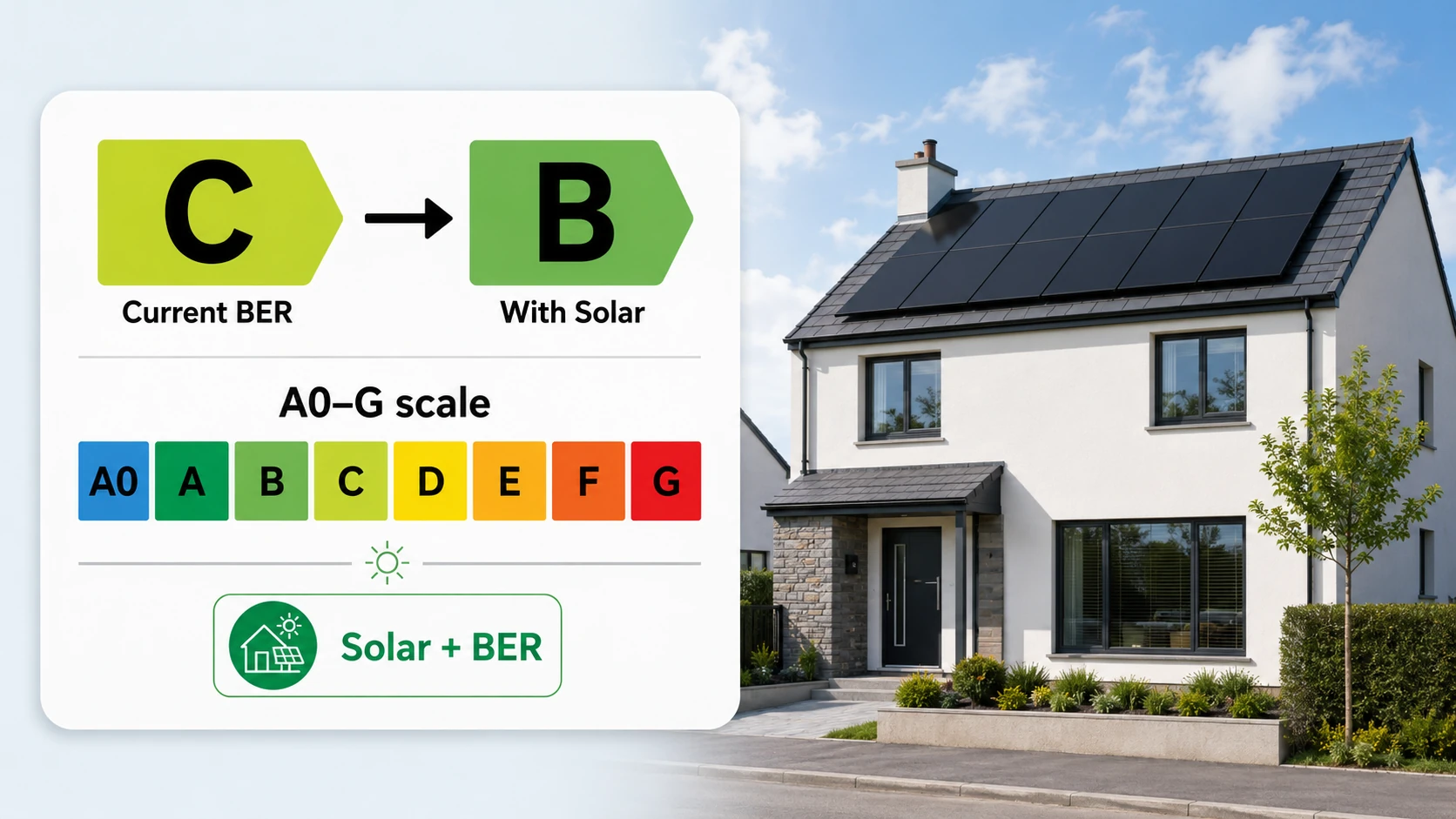
With Ireland’s New BER Scale, Does Solar Still Improve Your Rating?
See how solar panels affect your BER under Ireland’s new A0–G scale and current DEAP method, including batteries, exports and green mortgage impacts.
Solar still improves your BER rating but often less than before. And the calculations are now more detailed.
Your home’s BER matters for more than energy bills. It can affect mortgage rates, loan rates, access to retrofit grants and future sale value. And both the rating scale and the way solar counts towards BER have now changed.
We built the AirPV BER Calculator to make it easier to estimate how adding solar PV could affect your rating.
Quick guide
- What's changed? New BER scale and DEAP method.
- Does solar still improve your BER? Yes, but often by less. Solar used in home now gets more credit than solar exported to grid.
- What solar systems give most uplift? Larger solar installations that include a battery, and homes that have high electricity demand that can be met by solar.
- When does the new cert apply? From 24 May 2026. So from now, any new cert uses the new BER system. Note that the SEAI solar grant requires a new BER assessment to be completed after solar installation.
- What happens to my current cert? Existing BER certificates remain valid for up to 10 years from their date of issue.
- Why does BER matter? It can affect mortgage rates, loan rates, access to retrofit grants and future sale value.
New BER scale
The Building Energy Rating (BER) rates the energy performance of your home. Since 24 May 2026 [1], new BER certs use a simpler scale with 8 levels: A0, A, B, C, D, E, F and G. The old scale had 15 levels such as A1, B2 and C3.
Existing BER certificates remain valid for up to 10 years from their date of issue. However, any new certificate will use the new scale. So if you are installing solar now and need a post-works BER, your updated rating will be shown on the new A0–G scale. If you are applying for the SEAI solar grant, you need to get a new BER assessment after the installation so this will be on the new scale.
New DEAP methodology
A BER assessor uses the Dwelling Energy Assessment Procedure (DEAP) to assess your home and assign a BER level [2]. DEAP includes details on how adding solar impacts your BER rating.
The older DEAP method was simpler and only depended on home floor area and PV system details. For BER purposes, it did not matter whether the solar electricity was used in the home or exported to the grid. Battery size also did not affect the BER uplift.
With the new method now in place, solar PV is calculated month by month. The calculation estimates how much solar is used directly in the home and how much is exported to the grid. Solar used in the home gets more BER credit than solar exported to the grid.
This means the result is no longer based only on the solar system and home floor area. It can also depend on battery size and the home’s standard electricity-demand profile, including whether hot water or heating is electrically driven.
What does this mean in practice?
If you are installing solar now, your post-works BER will use the new A0–G scale and the new DEAP method. Solar still improves BER, but the uplift tends to be smaller with the new system. It can be around a third less of an uplift for a typical system without a battery.
The new method provides more uplift for solar that is estimated to be used in the home. A battery, electric hot water or higher daytime electricity demand can increase the share of solar counted as self-used, which can improve the BER result.
Why does BER matter?
Your BER level matters for more than energy bills. It can affect your mortgage rate, access to other grants and loans, and your home's resale value.
Green mortgage
A green mortgage offers lower interest rates for more efficient homes. This tends to apply to homes that have a rating of B or higher. Although, Bank of Ireland EcoSaver is especially relevant because it offers BER-linked discounts across the BER scale, not just B-or-better.
Most major lenders such as AIB, Bank Of Ireland and PTSB offer green mortgage rates. The discount varies a lot. The BER-linked discounts are often around 0.2 to 0.50 percentage points. The gap between standard and green mortgage rate can be even higher in certain cases.
Even small mortgage-rate discounts can be financially significant because they apply to the full mortgage balance. As a rough guide, on a €300,000 mortgage over 25 years, a 0.25 percentage-point rate reduction could save about €40 per month, or around €500 per year. A 0.50 percentage-point reduction could be worth about €80 per month, or around €1,000 per year. The exact saving depends on the mortgage size, term, lender, loan-to-value and fixed-rate product.
Retrofit grants
For homeowners planning multiple energy upgrades, SEAI’s One Stop Shop route can manage the process and provide access to a wide range of grants [3]. Part of the eligibility is that a home must reach a minimum BER level of B after the works. A solar installation can help reach the required level.
HEULS loan
The Home Energy Upgrade Loan Scheme (HEULS) is a low-cost loan option for energy upgrades that is government backed [4]. Loans are available from €5,000 to €75,000, with terms of up to 10 years. Interest rates vary by lender, but are designed to be lower than standard market rates.
To qualify, the planned works must be expected to improve the home’s BER by at least 20%. For complete home upgrades and community grant projects, the home must also achieve a minimum B rating. Solar PV can help contribute to the BER improvement. See the HEULS website for details about what the loan can be spent on.
Home resale value
The BER rating is an increasingly important factor for buyers and can impact the resale value of the home. Research in Ireland has also found that better BER ratings are associated with higher sale and rental values [5].
This is also linked to mortgage access. A more efficient home may be easier for buyers to finance if it qualifies for BER-linked mortgage products.
Ready to check for your home?
Use the AirPV BER Calculator here:
If you are ready for solar quotes, simply Enter your Eircode on AirPV and you can compare quotes from local, trusted installers.
AirPV is free, private and no spam. No obligation, no fuss.
Have questions? Or like a free custom calculation to see the number of panels for your home?
Email: scott@airpv.ie
Scott, Founder of AirPV
[1] https://www.seai.ie/ber/new-simplified-scale
[2] https://www.seai.ie/ber/support-for-ber-assessors/deap
[3] https://www.seai.ie/grants/home-energy-grants/one-stop-shop/multiple-energy-upgrades
[4] https://www.seai.ie/grants/home-energy-grants/home-energy-upgrade-loan
[5] https://www.esri.ie/system/files/publications/RB20140103.pdf